W3 Wine School

New Zealand Grape Plantings

Sauvignon Blanc has had an enormous growth in the 21st century.

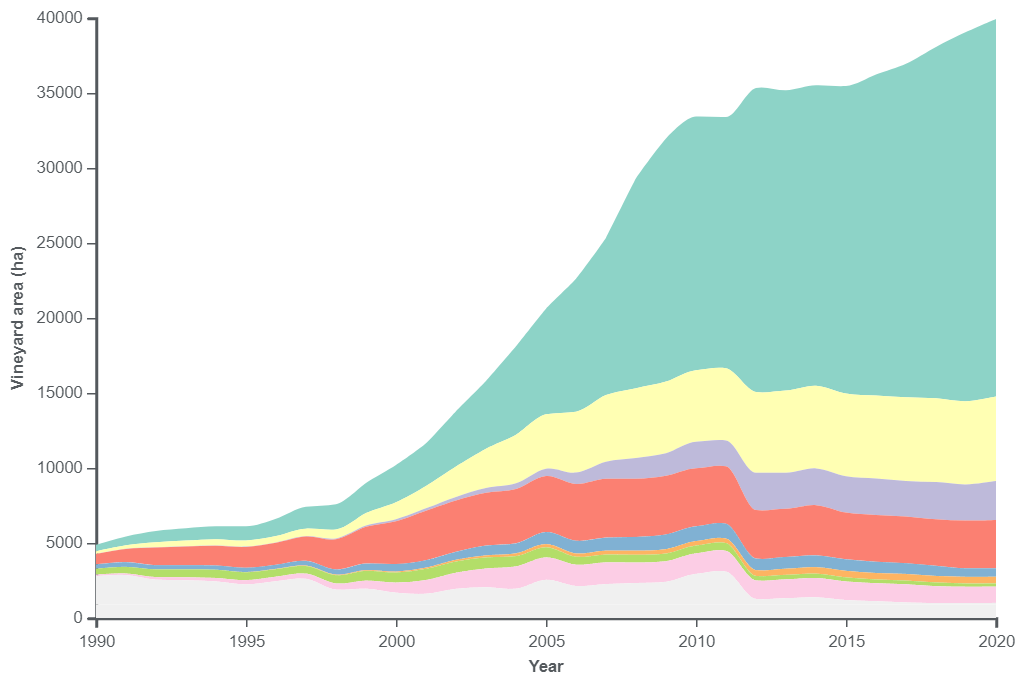
Driven by the Marlborough region, the area has expanded from 4.500 hectares in 2003 to 23.000 hectares in 2020 (26.500 hectares in 2022).

New Zealand vineyard area by grape 1990 – 2020:
Graph
Sauvignon Blanc Pinot Noir Pinot Gris
Chardonnay Riesling Syrah
Cabernet Merlot Other

A more than 5 times growth of Sauvignon Blanc is evident.

A doubling of Pinot Noir, a tripling of Syrah, and a rapid growth of Pinot Gris is visible.

Riesling and Chardonnay are unchanged, while Cabernet Sauvignon and Merlot have declined.

Statistics from New Zealand Winegrowers annual reports.


Sauvignon Blanc
27 500 hectares
Pinot Noir
5 900
Chardonnay
3 200
Pinot Gris
2 900
Merlot
1 150
Riesling
620
Syrah
500

Source: New Zealand Wingrowers 2022

New Zealand Wine Regions

New Zealand is renowned both for its stunning landscapes and its diverse wine regions.

Even with a small wine production, compared to other countries, New Zealand has gained international recognition for its high-quality wines, particularly Sauvignon Blanc and Pinot Noir.

Whether you're a fan of crisp Sauvignon Blanc, elegant Pinot Noir, or rich Bordeaux-style blends, New Zealand has something to offer for every wine enthusiast.
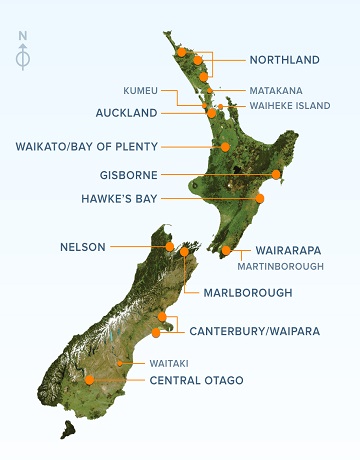
Marlborough, South Island (30.500 ha)

Located at the northeastern tip of the South Island, Marlborough is the largest and most famous wine region in New Zealand.

Marlborough is primarily known for its world-class Sauvignon Blanc, characterized by its vibrant tropical fruit flavors and crisp acidity.

The first plantings was in 1973 by Montana Wines (now Brancott Estate). In the 1980s, Marlborough Sauvignon Blanc burst onto the international scene. The region has since become a benchmark for cool-climate Sauvignon Blanc.

Marlborough now includes over 500 growers and 140+ wineries.


Key Grapes


Sauvignon Blanc (25 200 hectares)

Marlborough Sauvignon Blanc set the standard for the varietal globally in the 1980s.

It is a global icon, recognized for its zesty acidity, intense tropical and citrus fruit, and vibrant herbal character.

The style is crisp, aromatic, with flavors of gooseberry, passionfruit, grapefruit, lime zest, and sometimes jalapeño or fresh-cut grass.

Vibrant, clean, and high-acid, most often produced in stainless steel to preserve freshness, but blends or oak-aged versions (Fumé Blanc) are emerging.

Pinot Noir (2 500 hectares)

Pinot Noir is the second-most important variety in Marlborough.

The style is light to medium-bodied with red cherry, plum, and earthy spices.

It is especially suited to the Southern Valleys, where clay soils add the neccessary depth and structure.

Quality is increasing , with single-vineyard and reserve labels now common.

Pinot Gris (1 250 ha)

Marlborough Pinot Gris is vibrant and aromatic with flavors of ripe pear, green apple, and stone fruit, hints of quince, citrus, and floral or mineral notes.

It is richer and more complex than Italian Pinot Grigio, and often off-dry with a refreshing finish.

Chardonnay (1 100 ha)

Styles range from crisp and unoaked to rich and barrel-fermented. Often shows well-structured stonefruit and citrus with excellent intensity and complexity.

Some are lean and mineral, others are rich and creamy depending on oak use. Most winemakers focus on texture and complexity.

Aromatic Whites

Riesling, and Gewürztraminer are also grown here, often in smaller quantities.

The Riesling can be made in dry to sweet styles, showcasing lime, honeysuckle, and high acidity.


Sub-Regions

Wairau Valley

  • Warmest and sunniest sub-region
  • Gravelly soils, alluvial fans
  • Known for fruit-driven Sauvignon Blanc and aromatic whites

Southern Valleys

  • Rolling hills with clay-rich soils
  • Cooler and slower-ripening, ideal for structured Pinot Noir
  • Also good for Chardonnay and other aromatics

Awatere Valley

  • More extreme: windier, cooler, drier
  • Sauvignon Blanc is more herbaceous, with higher acidity
  • Increasing reputation for Pinot Noir
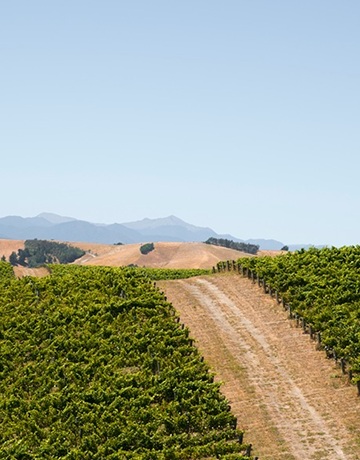
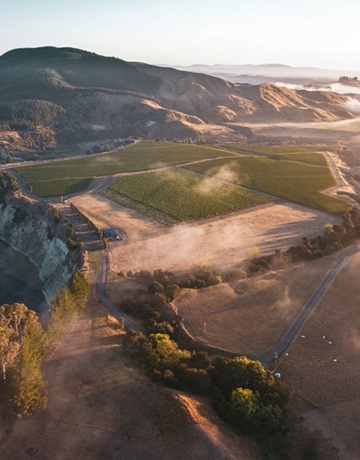
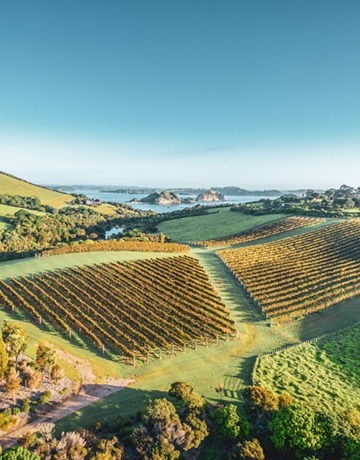
New Zealand Marlborough

Image credit: New Zealand Wine


Climate

Marlborough has a cool to moderate maritime climate:

  • Long sunny days
  • Cool nights

This significant diurnal temperatures variation enhances the aromatic development and the acidity retention in the grapes.

The region has low rainfall during the ripening and harvest season (ideal for disease control).


Soils

The soil is mostly free-draining alluvial soils with gravel and sand over clay or silt loams.

  • Wairau Valley
    gravelly and stony - ideal for aromatic whites

  • Awatere Valley
    drier, windier, and cooler - more herbaceous wines

  • Southern Valleys
    more clay-rich soils - good for Pinot Noir

Hawke's Bay, North Island (4.800 ha)

Climate: Warm and dry, with a diverse range of soils.

Notable: Known the Gimblett Gravels sub-region, which produces premium red wines.

Located on the eastern coast of the North Island, Hawke's Bay is New Zealand's oldest wine region and has a diverse range of microclimates.

Hawke's Bay is New Zealand's second largest wine region. The wine production began in the 1850s when a Marist priests from Lyon in France, planted the first vines. Today there are over 40 wineries in the region.

Hawke's Bay is known for its Bordeaux style red wines, and the region also produces exceptional Chardonnay, as well as some excellent Sauvignon Blanc.

The Gimblett Gravels sub-region within Hawke's Bay is particularly well-known for its unique stony soils, which produce intensely flavored red wines.

Central Otago, South Island (2.000 ha)

Climate: Continental, with hot summers and cold winters.

Notable: Renowned for its high-quality Pinot Noir.

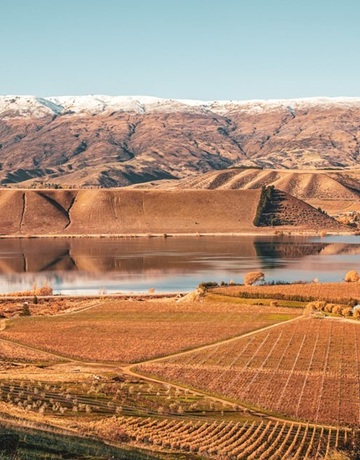
Situated in the southern part of the South Island, Central Otago is renowned for its stunning alpine landscapes and distinctive cool-climate wines.

Central Otago is most famous for its Pinot Noir, which thrives in the region's schist soils and continental climate. Some of New Zealand's very best Pinot Noir are produced here.

The area also produces excellent white wines, including Riesling, Chardonnay, and Pinot Gris.

Central Otago is the southernmost wine-growing region in the world, making it one of the most unique wine regions globally.

Canterbury, South Island (1.500 ha)

Climate: Cool with low rainfall.

Notable: The Waipara Valley is recognized for its high-quality Rieslings.

"Canterbury’s stunning Waipara Valley is one of the unsung heroes of the wine industry"
BOB CAMPBELL MW, 2004, AIR NZ INFLIGHT MAGAZINE

Gisborne, North Island (1.250 ha)

Climate: Warm and sunny.

Notable: Often called the "Chardonnay Capital of New Zealand."

Located on the eastern coast of the North Island, Gisborne is one of the warmest and sunniest wine regions in New Zealand.

Gisborne is known for its aromatic white wines, particularly Chardonnay and Pinot Gris.

The region also produces some excellent Pinot Gris and Viognier, as well as small amounts of red varieties such as Merlot and Malbec.

Wairarapa, North Island (1.100 ha)

Climate: Cooler climate, with significant diurnal temperature variation.

Notable: Includes the Martinborough sub-region, which is highly regarded for its Pinot Noir.

Nelson, South Island (1.050 ha)

Climate: Moderately warm and sunny.

Notable: Known for its boutique wineries and organic wine production.

Situated at the northwestern tip of the South Island, Nelson is a boutique wine region known for its artisanal producers and diverse range of grape varieties.

Nelson vineyards concentrate on grape varieties suited to cooler conditions.

Nelson produces outstanding aromatic white wines, including Sauvignon Blanc and Pinot Gris.

The region also excels in crafting elegant Chardonnay and Pinot Noir.

Auckland, North Island (250 ha)

Climate: Warm and humid.

Notable: One of New Zealand's oldest wine regions. Established in the early 1900s by passionate Croatian, Lebanese and English winemakers.

Aukland is known for its Bordeaux Blend varieties (70% Merlot, with Cabernet Sauvignon and Cabernet Franc) but also for its Chardonnay and Syrah.

The region includes sub-regions like Waiheke Island, known for high-quality reds, and Kumeu, renowned for its Chardonnay.

Northland, North Island (75 ha)

Northland is the northernmost wine region in New Zealand, extending from the tip of the North Island down to Whangārei, and west and east to both coasts.

The region is the birthplace of viticulture in New Zealand:
In 1819, missionary Samuel Marsden planted the first grapevines in Kerikeri, where the vinery has a long, albeit intermittent, winemaking history.

Vineyards are generally clustered in the coastal areas around Whangarei, the Bay of Islands and Kaitaia, taking advantage of both the flatter coastal land and the tempering sea breezes.


Sub-Regions

Commercial winemaking was dormant until the late 20th century, when small vineyards began to revive wine potential of the region.

Kerikeri

  • The most developed wine region in Northland
  • Home to pioneering estates (Marsden Estate and Ake Ake)
  • Offers tourism-friendly cellar doors, often paired with restaurants and accommodation

Whangārei and Mangawhai

  • Smaller but growing wine presence
  • Boutique producers focused on sustainable and organic practices

Grape Varieties

Northland is not dominated by a single grape variety like Marlborough’s Sauvignon Blanc. Instead, it produces a diverse range of wines, with an emphasis on full-bodied, ripe styles:

New Zealand Northland

Image credit: New Zealand Wine


Climate and Terroir

Northland has a subtropical maritime climate influenced by surrounding oceans.

  • The warmest wine region in New Zealand
  • Long, warm growing seasons
  • High humidity and moderate to high rainfall
  • Plenty of sunshine (less than Marlborough / Central Otago)
  • Early budburst and harvest, with grapes often picked in February (earliest in NZ)

These conditions allow for the ripening of both early and late-ripening grape varieties, with less risk of frost but a higher threat of mildew due to humidity.

Waitaki Valley, South Island (60 ha)

A new wine region (2001).
Complex limestone/greywacke/schist soils have attracted of a handful of passionate producers

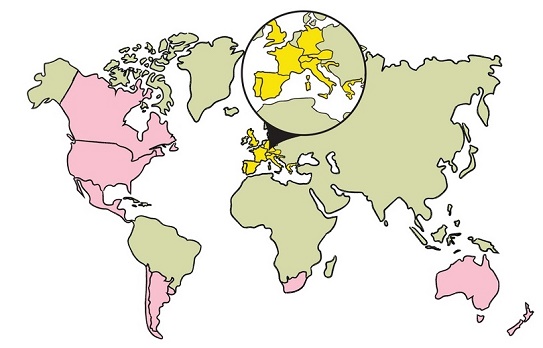
New Zealand is New World


Alcohol can be addictive. Always drink in moderation.

© Copyright 2015-2025 W3 Wine School. All Rights Reserved.